


Disclosure: I spent years at Yahoo DSP, which competes with The Trade Desk. I now run the Australian business of pubX, which works with publishers whose Safari revenue is affected by what follows. Read accordingly.
The short version
Picture a big office building. Every day, courier vans pull up to deliver parcels to the tenants. The building’s security desk keeps a list of courier companies that aren’t allowed in. Nobody outside building management has ever seen the list.
Last month, one of the biggest courier companies turned up and was turned away at the door. Its name was on the list.
That’s the story. The building is Safari, the web browser on every iPhone and iPad. The security desk is Apple. The parcels are ads. And the courier that got turned away is The Trade Desk, one of the largest companies that places ads on websites for advertisers.
Since Apple’s iPhone update on 14 September, The Trade Desk hasn’t been able to deliver a single ad into Safari on updated phones. It asked Apple why. Apple said it was looking into it. As I write, the official ticket tracking the problem has an “assigned to” field that reads “Nobody.”
A quick glossary
You can skip this if you work in ad tech. If you don’t, these four terms are all you need.
The Trade Desk (TTD). A company advertisers pay to buy ad space across thousands of websites automatically. When you see a banner ad on a news site, there’s a fair chance a company like this put it there. The industry calls them DSPs, short for demand-side platforms. In the building, they’re the couriers.
A domain. The address a company’s computers answer to, like thetradedesk.com. When a website loads an ad, your phone reaches out to an address like this to fetch it. If the phone refuses to contact that address, the ad never arrives.
Identity companies. When the old tracking cookies started dying around 2017, the industry built replacements: companies that work out whether the person on one website is the same person on another, usually by matching scrambled email addresses. Names you might hear: UID2, ID5, LiveRamp, Permutive. They’re how advertisers recognise you without cookies.
WebKit. The engine inside Safari. Apple publishes most of its code openly. Not all of it.
Eleven lines of code
In February, Apple added a tiny piece of code to Safari. Eleven lines. In plain terms, it says: “Before contacting any address, check it against a list. If it’s on the list, refuse.”
The public version of that code has the rule but an empty list. The real list lives in a file only Apple can see. Anyone reading Apple’s public code would have seen a rule that blocked nothing.
When the update went out to iPhones on 14 September, the list was switched on. On 21 September a Trade Desk engineer posted what was on it. Five identity companies: UID2, ID5, LiveRamp, Permutive and Audigent. A test entry. And adsrvr.org, the address The Trade Desk uses to deliver its ads.
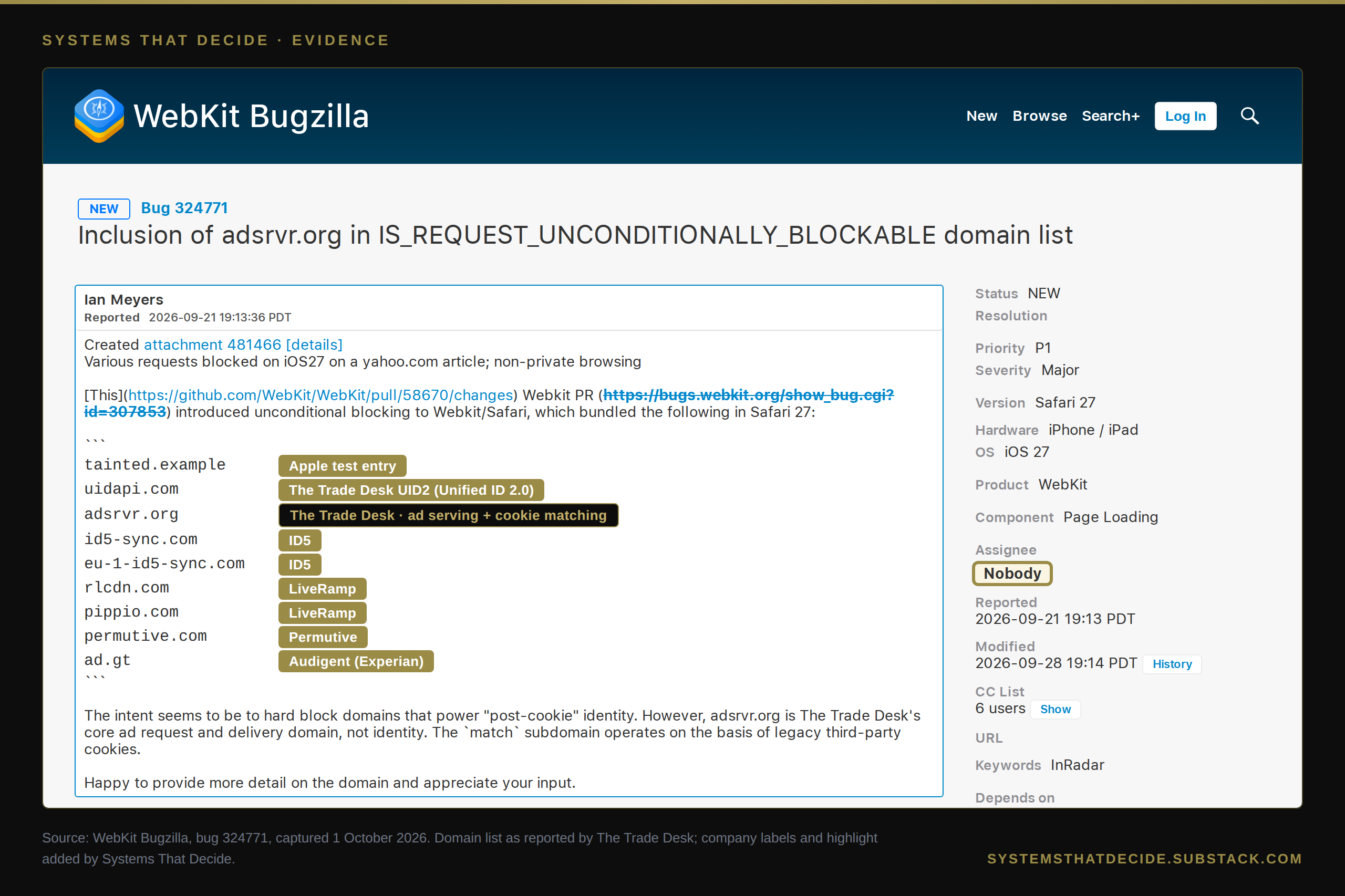
That last one is the problem. Blocking the identity companies stops advertisers recognising you. Blocking adsrvr.org stops The Trade Desk showing you anything at all.
Probably an accident, and a slightly embarrassing one
The Trade Desk uses that one address for two jobs. One part of it does old-style cookie matching, which is exactly the kind of tracking Apple dislikes. The rest of it delivers ads. Apple’s list blocks a whole address, every part of it. So when Apple went after the tracking, it caught the delivery too.
Back to the building. Imagine a courier company that sends its parcel vans and its snooping vans out under the same company name. Security bans the name to stop the snooping. The parcels get turned away as well.
The Trade Desk isn’t even arguing about the identity companies. Its complaint to Apple accepts that Apple meant to block tracking. Its point is only that its delivery address shouldn’t have been caught in the net.
That explains the result. It doesn’t make it fair.
Painful, not fatal
KeyBanc’s analysts estimate it could cost The Trade Desk a low single-digit percentage of annual revenue if it drags on, and close to nothing if Apple fixes it quickly. People take weeks to update their phones. In August, three-quarters of Australian iPhones were still on the previous version.
It lands at a bad time. The Trade Desk has told investors to expect revenue to fall about 12 per cent this quarter, and it has just cut 15 per cent of its staff.
What the LinkedIn version gets wrong
The story going around LinkedIn this week says Apple has declared war on independent ad companies, that Google’s ads kept flowing, and that Apple is protecting Google because Google pays Apple billions to be the default search engine.
Slow down. Two things are true. Google’s ad address did keep working in the same period. And nobody outside Apple has explained why. Maybe it’s deliberate, maybe Google’s address is classified differently, maybe it’s a mistake. Ask the question. Don’t treat it as proof of a motive.
Apple isn’t only hitting small players either. Audigent, on the list, is owned by Experian, a giant. A review of the new Safari’s code in July found Microsoft’s Bing advertising tracker blocked too, along with LinkedIn’s. Microsoft is not a plucky independent.
One more claim to be careful with: that Chrome on iPhones is affected too, because it runs on Apple’s engine underneath. It might be. Nobody has shown it yet. Test before you repeat it.
Two referees
Last month, a US judge finished the biggest advertising antitrust case in a generation, against Google. It took 43 months from complaint to ruling. The result was a 106-page decision, six years of rules, an independent monitor, regular reports, and a right to appeal. You can argue about whether the rules are tough enough. But every step was argued in open court and bound by law.
Now look at the other referee of the internet.
Apple decided which companies can deliver ads to roughly half of Australia’s mobile web browsing. The list isn’t published. The reasons aren’t published. The only way to complain is a public bug report. The only promise on offer is that Apple will get back to you “if and when” something changes. And Apple can reportedly update these lists without even releasing a new version of Safari.
I don’t think Apple is acting in bad faith. It has been consistent for a decade: it thinks tracking people across websites is wrong, and it acts on that. My worry is the power. The court case produced rules with a process. The browser produced a result with no process at all. One took 43 months. The other took a phone update.
This newsletter keeps asking one question: who controls the systems that decide where the money goes? For ads on phones, the honest answer is whoever keeps the list.
The part that won’t get fixed
My prediction: Apple takes The Trade Desk’s address off the list, possibly within weeks. Ads flow again. Headlines say “Apple backs down.” Everyone moves on.
Don’t. The other names on that list weren’t a mistake. UID2, ID5, LiveRamp, Permutive and Audigent are how the independent ad industry survived the death of cookies. On the newest Safari, on half of Australia’s mobile browsing, they’re now refused.
This is the third time the same thing has happened:
In 2017, Safari killed tracking cookies. Websites could still sell ad space, but couldn’t prove who saw it, so they got paid less.
The industry built identity companies to replace cookies. They worked best for the giants who already knew who you were because you were logged in, like Google and Meta. Not for the average news site.
Now Safari has blocked the workaround.
Fixing The Trade Desk is one line deleted from a file. Nothing is coming from Apple to fix the rest.
Why this is an Australian story
Australia is writing its own rules for exactly this, right now.
The Government’s draft privacy changes, released on 31 August and known as Tranche 2, say that if a business shares your personal information for advertising, it needs your consent. The Government’s own explanation gives the example of cookies and tracking pixels in online advertising. The draft also says you count as identifiable even if nobody knows your name, as long as you can be singled out. The Privacy Commissioner already took that view in June, in rulings against Monash IVF and Medmate over tracking pixels.
So Canberra and Apple are going after the same thing with opposite ideas. Canberra says: ask people properly, get their consent, treat them fairly, and you’re allowed. Apple says: if your address is on the list, you’re blocked, and consent doesn’t come into it.
That leaves an Australian website in a strange spot. It could follow the new law perfectly, get every visitor’s proper consent, and still lose the ad on an iPhone. Consent fixes your legal problem. It doesn’t fix your Apple problem.
It gets sharper. Under the draft, targeting ads at a broad group of readers, say “people interested in cars,” doesn’t need consent at all. That’s roughly what Permutive helps news sites do with their own readers. Permutive is on Apple’s list. So on this point, a company in California is already stricter than the law Australia is proposing, and nobody here was asked.
The draft law will take a year or more to be debated and passed. Apple’s list took effect on 14 September.
What to do about it
If you buy ads, ask whoever runs your campaigns what share of your Australian ads ran on iPhone Safari before and after 14 September. If your numbers dropped there, your ads may not be performing badly. They may not have been delivered. If nobody can tell you, you’ve learned something about who’s running your campaigns.
If you run a website that sells ads, check how much you earned from iPhone Safari visitors since mid-September, broken down by which ad company was buying. The drop won’t be even, and it will show you how much of your business rests on the identity companies Apple just blocked.
And for everyone: any plan for the open web that relies on recognising people inside the browser now relies on the goodwill of the company that makes the browser. Plan as if the list gets longer.
What to watch
The Trade Desk’s ticket with Apple. Whether its address comes off the list, and whether Apple explains why. A quiet fix tells you as much as a public one.
Whether Apple publishes the list, or its rules for who goes on it. That’s the difference between a policy and a switch.
The Trade Desk’s results in early November. Whether it puts a number on this, and whether it calls it a bug or a risk.
The Chrome on iPhone question. Someone will test it this month. Until then, don’t repeat it.
Canberra. Whether the final privacy law says anything about what happens when the law allows something and Apple blocks it. My guess: it won’t.
Systems That Decide publishes on the infrastructure of decision-making in marketing and advertising. If this edition was useful, send it to someone who thinks privacy in Australia is being decided in Canberra.