

The most consequential document in advertising right now is one most people haven't read
AdCP vs AAMP, containerised DSPs, Sponsored Intelligence, and why Amazon sits outside the logic entirely.
Something happened in December 2025 that most of the industry read as a technical milestone. It was not. It was a political one.
Magnite, one of the world’s largest supply-side platforms, ran the first live agent-to-agent media transaction using a new protocol called AdCP. A piece of software acting on behalf of a buyer negotiated directly with a piece of software acting on behalf of a publisher group. LG Ad Solutions, Warner Bros. Discovery, MiQ. Real inventory, real money, no human making the buy decision.
The industry covered it as a technical proof-of-concept. What it actually was: the first live test of who gets to write the rules for a buying process that could eventually replace the entire stack of interfaces, platforms, and intermediaries sitting between a brand’s objective and a media impression.
The first piece in this series framed the Publicis and Trade Desk dispute as a power question, not a transparency one. The same logic applies here, one layer down. The companies that write the standard governing how agents communicate when buying media will define who sits at the centre of every agentic transaction and who sits at the edge. That is the decisioning fight by another name.
Understanding why requires understanding one variable.
The one variable
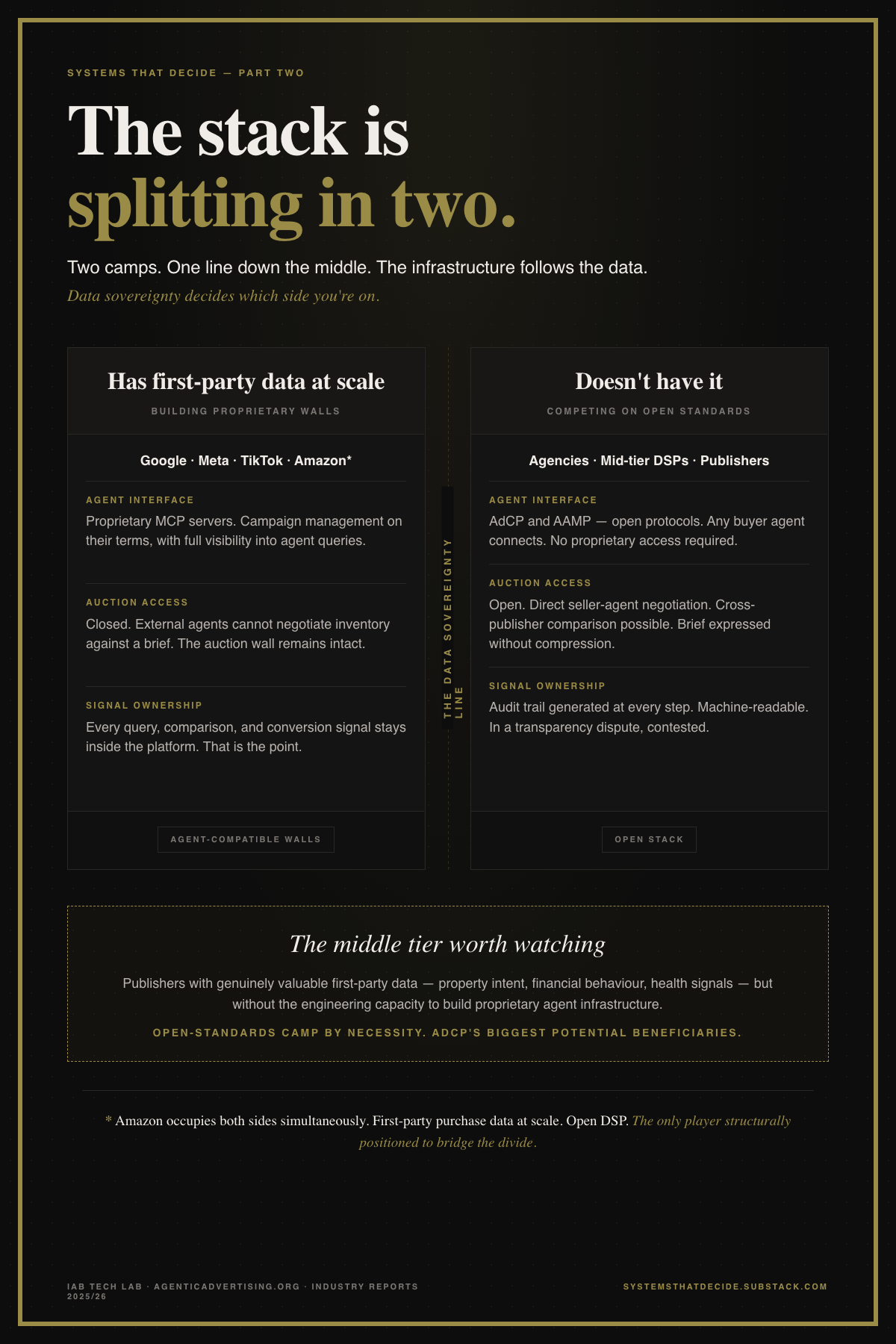
The stack is splitting along first-party data at scale.
Entities that have it (user behaviour, purchase history, payments data) are building agent-compatible walls. Proprietary MCPs, on their own terms, with full visibility into how agents query them and what signals they surface. Entities that don't have it are competing within open standards, because open standards are the only infrastructure they can access. Publicis acquiring LiveRamp for $2.167 billion this week is what crossing that line looks like.
There is a middle tier worth naming. Publishers with genuinely valuable first-party data (property intent, financial behaviour, health signals) but without the engineering capacity to build proprietary agent infrastructure. They sit in the open-standards camp by necessity, but they are potentially its biggest beneficiaries. AdCP gives them direct access to buying agents without needing an SSP or DSP to intermediate. That asymmetry is underreported.
Every product announcement, every protocol launch, every governance body decision in this space maps back to that divide.
The Publicis acquisition of LiveRamp, announced this week for $2.167 billion, is the most concrete proof yet. Most coverage is framing it as an agentic play. That is not wrong. It is incomplete. Publicis is buying their way to the right side of the data sovereignty line. The agents are the output. The data is the moat.
Understanding which camp any given player occupies tells you more about how the stack restructures than anything the trade press is currently writing.
The protocol fight
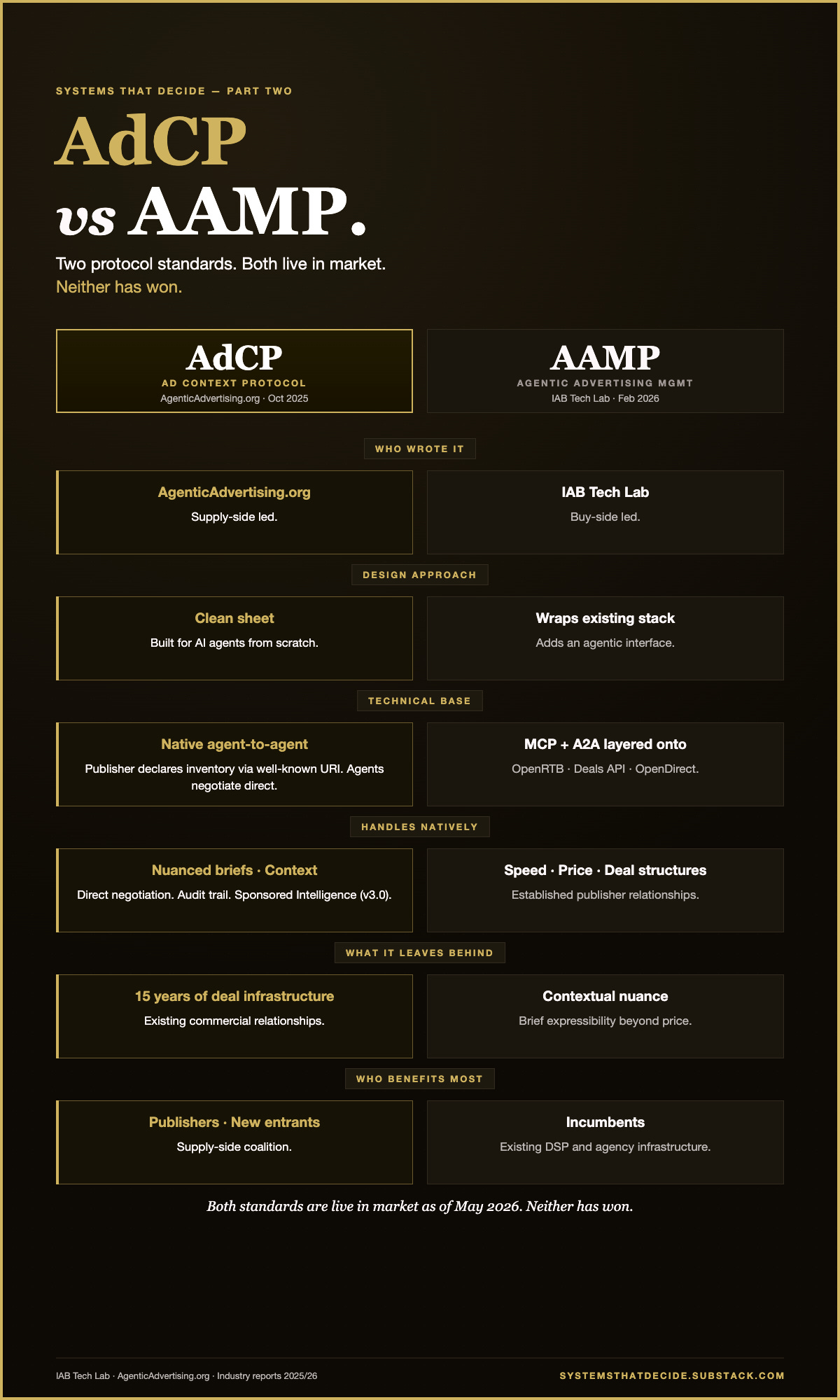
Two standards are competing to govern agentic media buying. Neither has won. Both are live in market.
AdCP, the Ad Context Protocol, launched in October 2025 by a coalition of more than 20 organisations including Yahoo, PubMatic, and Scope3. Clean-sheet design, built from the ground up on the assumption that both buyer and seller are AI agents. Under AdCP, a publisher declares its inventory and deal conditions at a standard web address. A buyer agent reads that file, connects to the seller agent, requests available inventory against a brief, and confirms a buy. At every step, the buyer agent logs its reasoning. That log is the audit trail. In a market in the middle of one of the most public transparency disputes in programmatic history, a machine-readable record of every buying decision is not a neutral technical feature. It is a commercial and political one.
AAMP, the IAB Tech Lab’s competing standard, takes the opposite approach. Rather than rebuilding from scratch, it wraps the existing programmatic stack (OpenRTB, the Deals API, OpenDirect) with agent-compatible connectors. The case for it is simple: fifteen years of deal infrastructure, publisher relationships, and commercial agreements do not get retired. They get a new front door. The argument against is that grafting LLM reasoning onto OpenRTB parameters leaves too much behind. A buying agent briefed to find inventory aligned with a sustainability narrative at a specific CPM range cannot fully express that brief within a schema built for speed and price. AdCP was designed to carry the full brief. OpenRTB was not.
Before taking a position: the organisations most actively building AdCP are supply-side players. PubMatic. Magnite. Scope3. The standard that disintermediates the demand side is being written by the supply side. That is not a coincidence. It is a commercial interest. The same logic applies to AAMP. The IAB Tech Lab’s member base is heavily buy-side, the agencies and DSPs whose existing infrastructure AAMP is designed to preserve. Both standards are written by parties with a stake in their adoption. Anyone evaluating which to build on should factor in who benefits most if it wins.
Where I stand
AAMP will win the near term. Not because it is better designed, but because it asks less of buyers.
Large buy-side organisations will not rebuild integrations from scratch. They will add an agentic interface to what they already have and call it done. AdCP is the right architecture for the long term. The clean-sheet design, the audit trail, the ability to carry a full brief without compression are the infrastructure of a genuinely different buying system.
AdCP’s Curation Protocol, planned for Q2 2026, is the most likely bridge between them. Whether it ships on schedule is the one variable to watch in the protocol fight. If it does, there is a path to convergence on AdCP’s architecture. If it slips, AAMP calcifies as the market default.
Watch the schedule. Not the announcements.
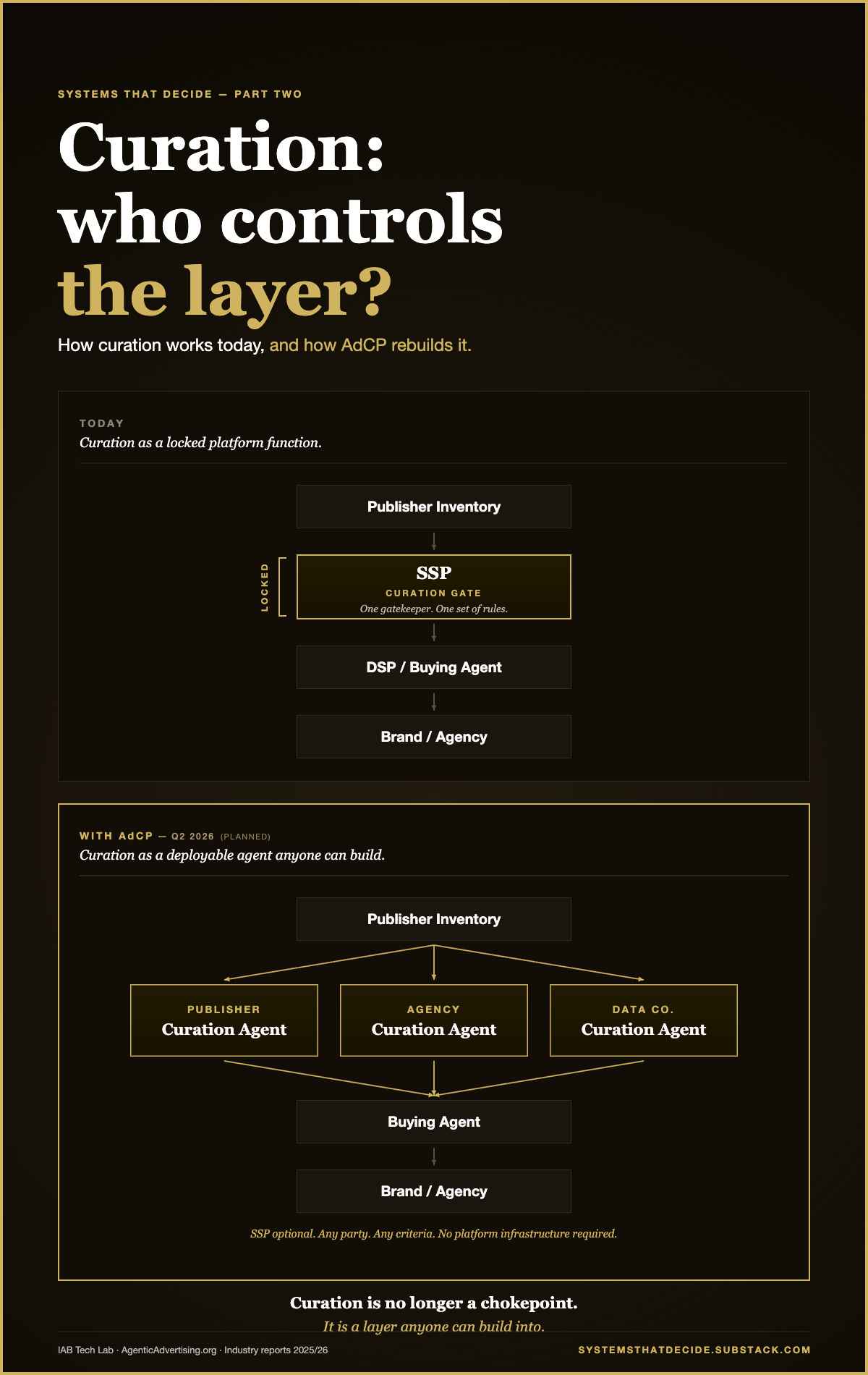
The more consequential implication of the Curation Protocol is structural. Curation, the packaging of inventory against specific signals or brand criteria, currently happens inside SSP infrastructure. You need the platform to do it. When the Curation Protocol ships, any agency will be able to build a curation agent that packages inventory across publishers without touching SSP infrastructure. The function locked inside specific platforms becomes available to anyone who can build the agent. Where value gets created in the supply chain moves with it.
The wall nobody is talking about
The traditional model assumes inventory flows from publisher to SSP to exchange to DSP to agency to brand. In an agentic stack, that chain is under pressure at every joint simultaneously.
On the demand side, Adam Roodman (Yahoo’s head of DSP) said something in early 2026 that the industry has not fully processed: “We don’t care if you don’t use our UX anymore.” Yahoo is repositioning itself not as a platform you log into, but as infrastructure your agents plug into. The seat is no longer the point. The data and the signal are. On the supply side, PubMatic’s AgenticOS had run more than 30 fully autonomous campaigns with more than 1,000 direct publisher deals by May 2026, built deliberately on the supply side. They are not waiting for a DSP to arrive with an agent. They are building infrastructure for buying agents to come directly to inventory.
Meanwhile, every major walled garden has launched its own MCP server. Google. Meta. TikTok at TikTok World on 13 May 2026, with explicit intent to let AI agents plan, launch, and optimise campaigns without manual intervention. This looks like the wall coming down. It is not.
Every one of these is a campaign management interface, not an auction access point. An AI agent using TikTok’s MCP can adjust bids and shift budgets inside TikTok’s platform. It cannot negotiate TikTok inventory against a brief using AdCP or AAMP. The auction remains closed. The walled garden remains intact. What has changed is the front door.
The reason each platform is building its own MCP rather than plugging into an open standard was stated plainly by adtech expert Shirley Marschall in coverage of the TikTok launch: “If you route through someone else’s MCP, you lose visibility into how agents are querying you, what they’re comparing you against, what’s driving conversion. In an agentic world, that’s your most valuable signal, which you don’t want to hand to a third party.”
This is the data sovereignty thesis playing out in real time. The walled gardens are not opening. They are building agent-compatible walls. An external buying agent running on open standards today cannot reach Facebook inventory, YouTube inventory, or TikTok inventory through that agent. The framing of this as platforms “opening up” to agentic buying is the coverage getting it wrong.
There is one platform that sits outside this logic entirely.
When the surface is a conversation and the buyer is a machine, what does a brand actually buy?
Amazon: The exception
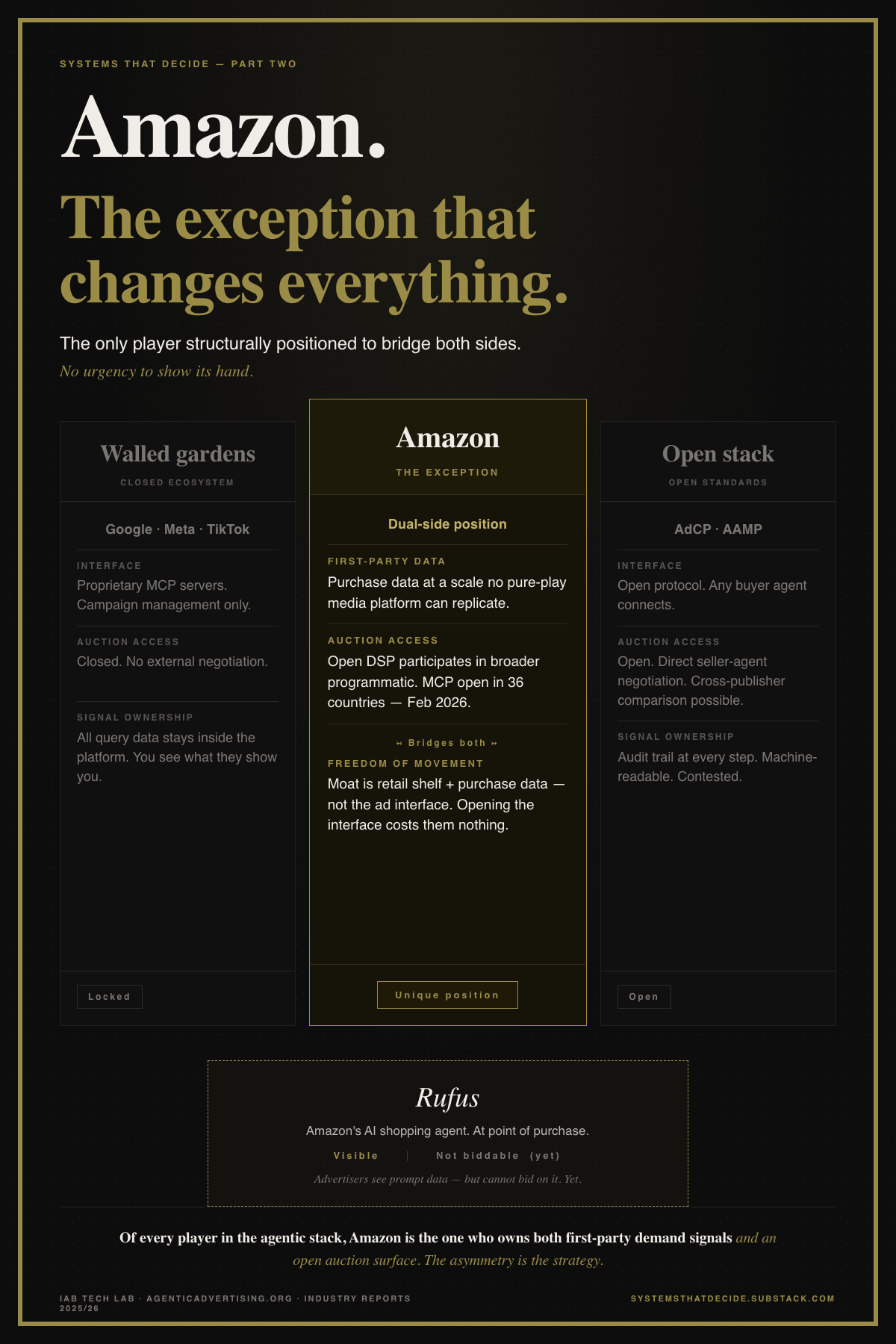
Every platform described above sits on one side of the data sovereignty line and protects it accordingly. Amazon does not.
Amazon sits simultaneously inside the walled garden and within the open stack. First-party purchase data at a scale no pure-play media platform can replicate. An open DSP that participates in the broader programmatic ecosystem. And Rufus.
Rufus is Amazon’s consumer-facing AI shopping agent. It sits at the point where consumers discover and decide. It is already integrated into Amazon’s monetisation and reporting layer. Advertisers can currently see Rufus prompt data inside Amazon’s own reporting. They cannot yet bid on it.
That gap, between visible and biddable, is the most important unresolved question in retail media. When Amazon opens Rufus to advertiser demand, they will have built something no other platform can replicate: an AI-native advertising surface inside a walled garden, at the point of purchase, with transaction data closing the attribution loop. Meta has user data but not purchase data. TikTok Shop is building toward this but is years behind at scale. Google has search intent, but AI search is disrupting it from within.
They are blocking nearly 50 AI crawlers from amazon.com via robots.txt while opening the MCP door. One door open, one door closed. This is not inconsistency. It is a deliberate access architecture: let agents manage campaigns inside our platform, on our terms, while controlling precisely what those agents can observe.
Amazon is not rushing to become the bridge between open-web agentic infrastructure and walled-garden inventory. But they are the only player structurally positioned to build that bridge if they chose to. Their moat is the retail shelf and the purchase data, not the advertising interface. Opening the interface does not undermine the moat. That asymmetry gives them a freedom of movement that Google, Meta, and TikTok do not have.
Whether they use it is the most interesting open question in the stack.
The question worth sitting with
The standard that governs agentic buying is being written now, in specifications and governance bodies that most practitioners in this industry are not reading. The companies that are reading them are shaping the rules: how agents transact, what data they have access to, what audit rights buyers retain, and what the cost of access looks like.
At every layer, the same question. Who is writing the rules? And what is your contingency if the layer you’re building on restructures without you?
The contingency is not a product decision. It is a position decision. Know which side of the data sovereignty line you’re on. Build your strategy from that reality rather than from the infrastructure you’ve always used.